So, you’re staring down a high speed reduction gearbox question—like, “wait, am I overbuying or underbuying?”—and let’s be real, I’ve gotten this exact text from at least 12 customers this month alone, because sizing these things feels like guessing your coffee order on a 3rd date: get it wrong, and your whole operation’s messy. Let’s break this down like we’re chatting over a break room coffee, no fancy jargon that makes you glaze over.
First, let’s get the basics out of the way: high speed reduction gearboxes (that’s the thing that takes a spinning motor, like a 3600 RPM motor that’s perfect for, say, a conveyor line, and slows it to whatever your machine needs—think 60 RPM for a packaging assembly) are not one-size-fits-all. I’ve seen a guy buy a tiny gearbox for a steel stamping press because it looked cheap, and it blew up in 2 days. Conversely, I had a food processing plant order a massive overkill unit that wasted 20% of their energy because they guessed wrong. So let’s avoid both.
Start with the two non-negotiable numbers everyone needs to dig up first, before you even open a Google tab for gearboxes. One: the output torque your machine requires. Torque is the grunt—how much force you need to move that load. Think of it like towing a trailer: torque is the pulling power, RPM is how fast you tow it. Two: the gear ratio, which is just how much you’re slowing the input (motor) RPM to get your desired output RPM. You can’t skip either—trust me, I’ve tried to tell people this, and they come back like “but I know my motor’s RPM!” Cool, but that’s only half the puzzle.
Let’s talk torque first, because this is where most people mess up. It’s not just the “running” torque—like, when your conveyor is moving boxes along. You also have to account for “starting” torque, which is way higher. If you’ve got a machine that’s lifting a 500lb pallet of product, starting it takes way more force than keeping it moving. Plus, add in safety factors—we always recommend 1.5x to 2x the calculated torque, because things pop up: a box gets stuck, the belt’s a little sticky, cold weather makes lubricants thicker. I once had a customer forget the cold weather factor for a warehouse in Minnesota, and their gearbox seized at 2 a.m. on a January night. Ouch.
Then the gear ratio part. Let’s do a quick example to make this real. Suppose you’ve got a motor that spins at 1800 RPM (super common for industrial motors), and your machine needs 90 RPM to run right. That’s a ratio of 1800 / 90 = 20:1. Simple enough, right? But wait—what if your motor’s actually variable, like if you have a VFD (variable frequency drive) to adjust speed? Then you’ve got to account for the max and min RPM ranges, because if your VFD cranks the motor up to 3000 RPM, your output would be 150 RPM, which might be too fast for your load. So you have to match the ratio to your max desired output RPM, not just the average.
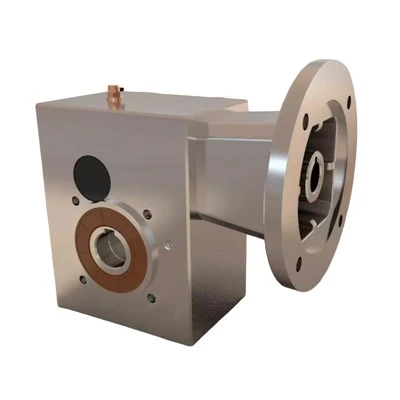
Now, let’s talk about the types of gearboxes we sell, because the size also depends on the type that fits your application. If you’re in food and beverage, stainless steel is non-negotiable because you need to wash it down all the time—our Stainless Steel Gear Reducer is built for that, no crevices where bacteria can hide. We use food-grade lubricants, so it’s compliant with FDA standards, which is a big one for bakeries, beverage plants, and pharmaceutical packing lines.
If you’ve got a application that needs smooth, quiet operation—like a lab conveyor or a small packaging machine—our Mini Gear Reducer might be perfect. These are compact, so they fit in tight spaces, and they handle lower torque loads, but they’re super reliable for small, precise jobs. I’ve had a customer use them for a medical device assembly line, and they’ve been running for 3 years without a single issue.
For general industrial stuff, like conveyors, material handling, or light manufacturing, Parallel Shaft Helical Gear Reducers are workhorses. They handle medium to high torque, are efficient (so you don’t waste energy on heat), and come in a bunch of sizes to match different motor power. We’ve got these in sizes from 0.5 HP up to 200 HP, so you can pick exactly what you need without buying extra.
Wait, what if you’ve got a application that needs a high reduction ratio—like 100:1 or higher, which is hard for helical gearboxes alone? That’s when Helical Worm Gear Reducers or Worm Speed Reducers come in. Worm gears can get those super high ratios in a compact package, though they’re a little less efficient than helical ones, so they’re best for applications that don’t need constant high load. For example, a door opener that only moves a few times an hour—worm gear is perfect. But if it’s a conveyor running 24/7, helical is better for saving electricity.
Now, let’s get to sizing specifically. Once you’ve got your torque (calculated with safety factor) and your gear ratio, cross-reference that with the power of your motor. Motor power is usually in HP (horsepower) or kW (kilowatt)—1 HP is about 0.75 kW, if you need that. The gearbox has to be rated for at least that motor power, plus a little buffer. Let’s do another example: if you have a 5 HP motor, a 20:1 ratio, and you calculated a required torque of 1200 lb-ft (with a 1.5x safety factor), then you’d look for a gearbox rated for at least 5 HP and torque over 1200 lb-ft. That’s how you match size.
But wait, there are edge cases. What if your application is intermittent vs. continuous? If you’re only using the machine 8 hours a day, 5 days a week, you can go a little smaller than if it’s running 24/7, because continuous use generates more heat, and gearboxes overheat if they’re too small for constant load. I had a customer with a 24/7 packaging line try to use an 8-hour rated gearbox, and it burned out in 6 months—lesson learned.
Another edge case: environmental factors. If you’re using the gearbox outside, exposed to rain, dust, or extreme temperatures, you need a gearbox with a higher IP (ingress protection) rating, which usually means a bigger, sturdier housing. Our stainless steel gear reducers, for example, have high IP ratings, so they work great for outdoor food processing or agricultural equipment. If it’s a dusty construction site, a helical gearbox with a sealed housing might be better than an open mini gear reducer, which would get clogged in a week.
Wait, let’s bust a common myth here: more expensive = better size. No, not always. We’ve had customers buy the top-of-the-line gearbox that’s twice as big as they needed because the sales rep talked them into it, and now they’re wasting $500 a month on extra electricity. Conversely, buying the cheapest “right-sized” gearbox is risky, because cheap gearboxes use lower quality steel or worse lubricants, so they fail faster. It’s about matching the size to your exact needs, not over or under buying.
So let’s walk through a step-by-step checklist, so you don’t have to guess: 1. Find your motor’s RPM (input speed). 2. Find your required output speed (how fast your machine needs to move/operate). 3. Calculate the required gear ratio: input RPM / desired output RPM. 4. Figure out your required torque (running torque + starting torque) and multiply by 1.5-2x for safety. 5. Note your motor’s power (HP/kW). 6. Factor in use case (intermittent vs. continuous) and environment (indoors/outdoors, wet/dry, etc.). 7. Match all that to a gearbox type: stainless steel for food/pharma, parallel shaft helical for medium-high torque general use, helical worm for high ratios, mini for small loads, worm for intermittent high reduction.
Let’s test this with a real customer example from last month. A craft brewery reached out because they needed a gearbox for their bottling line conveyor. Their motor was 1750 RPM, desired output was 70 RPM, so ratio is 25:1. They calculated running torque was 400 lb-in, starting torque was 800 lb-in, so with a 1.5x safety factor, that’s 1200 lb-in. The line runs 12 hours a day, indoors, needs to be easy to clean, so stainless steel was a must. We hooked them up with a stainless steel gear reducer rated for 5 HP, 25:1 ratio, 1500 lb-in torque, and they’ve had zero issues in the 6 weeks since install. Perfect fit.
Another customer: a small robotics shop needing a drive for their 3D printer-style assembly arm. They had a tiny motor (0.25 HP, 3000 RPM) needing 100 RPM output, so 30:1 ratio. Required torque was low, around 50 lb-in, and they needed it to fit in a tight space, so we pointed them to our Mini Gear Reducer. It’s compact, lightweight, handled the load, and fit exactly where they needed it. No wasted space, no extra power.


Now, what if you’re still stuck? Don’t guess. We get dozens of emails a week from people who send us their specs, and we help them size it for free. I know it’s tempting to Google “gearbox size calculator” and plug numbers in, but those calculators are generic, and they don’t account for your specific machine’s needs—like if there’s a heavy load at start-up, or if you’re running 24/7, or if you’re in a wet environment. We’ve got gear reducers for every use case, so if you send over your motor specs, machine load, and where it’s being used, we can point you to the right size.
Wait, and don’t forget about mounting! Some gearboxes are flange-mounted, some are shaft-mounted, and that affects size too. If you’ve got a tight mounting space, a mini gear reducer or parallel shaft helical in a compact housing might work, but if you need to attach it to a big machine base, a larger helical worm gear reducer with a sturdy flange is better. That’s another thing generic calculators don’t factor in.
Let’s wrap this up: sizing a high speed reduction gearbox isn’t rocket science, but it’s about getting the right numbers (torque, ratio, power) and matching them to the right type of gearbox for your environment and use. Don’t overspend on extra size you don’t need, don’t underbuy and risk downtime, and when in doubt, reach out to us—we’re here to help. If you’ve got a project coming up, send us your details, and we’ll hook you up with the perfect size gearbox for your needs. Don’t let a bad gearbox derail your whole operation—get the size right first, and the rest is smooth sailing.
References:
- Power Transmission Engineering. “Gearbox Sizing Basics for Industrial Applications.” 2023.
- American Gear Manufacturers Association (AGMA). “Standard for Sizing Speed Reducers for Continuous Duty.” AGMA 6012-F15, 2015.
- Food and Drug Administration (FDA). “Food Equipment Design Standards for Processing Machinery.” 2022.
- Machine Design. “How to Select the Right Gear Reducer for Your Application.” 2024.